

 de
de
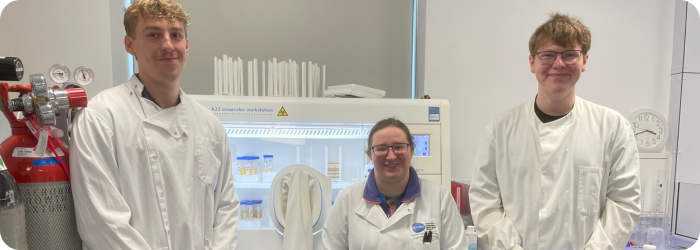
Third-year Biochemistry undergraduate Jack Fuller was recently awarded the DWS Travel Grant to present how the Whitley A35 Anaerobic Workstation advanced his research into growing antimicrobial resistance at the Microbiology Society Annual Conference 2026 in Belfast.
We asked Jack to share more about his study at the University of Bath and his experience at the conference:
"The research group I am working with primarily focuses on the growing antimicrobial resistance in ESKAPE pathogens and Clostridioides difficile (a gram-positive anaerobic sporulating bacterium) and how resistance contributes to the spread of infection in hospitals.
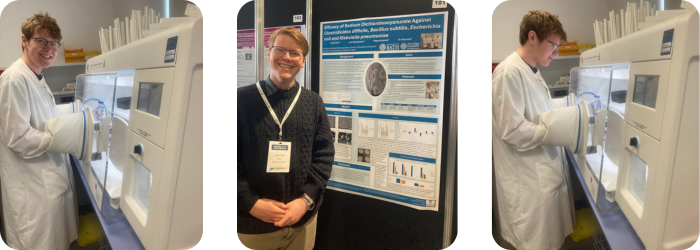
My research project evaluates the use of a Sodium Dichloroisocyanurate (NaDCC), a popular chlorine biocide, when disinfecting these pathogens. I investigated the adaptive properties of C.difficile when exposed to NaDCC at relevant levels to match hospital disinfection guidelines and procedures. A key component of my work was using and operating the Whitley A35 Anaerobic Workstation to culture C.difficile and regrowing tested C.difficile strains for further experiments.
I have found evidence that not only are C.difficile and other ESKAPE pathogens able to withstand recommended concentrations of NaDCC but also the process has been able to produce an adaptive change in the phenotypic properties of the C.difficile strains.
I am very grateful to have received the DWS Travel Grant as it has enabled me to travel to the Microbiology Society Annual Conference 2026 in Belfast to present my research findings. The grant allowed me to secure accommodation and my registration to the conference, guaranteeing my place and poster to be presented.
As a third-year undergraduate student undertaking this project on placement, this opportunity was my first time joining a conference, and it was such an exhilarating experience. I had never previously been among such a large community of microbiologists but was eager to rise to the challenge. Being able to present my poster and discuss my project with other interested scientists has filled me with further confidence about my work and my ability to present.
The DWS Travel Grant has helped show me how much of a positive experience going to conferences can be and has left me eager to return in the near future."
We thank Jack for providing such an insightful overview into his research and would like to congratulate him once again on receiving the DWS Travel Grant Award.
If you think that you might be eligible for the DWS Travel Grant, please visit our travel grant page for more details.





 England